
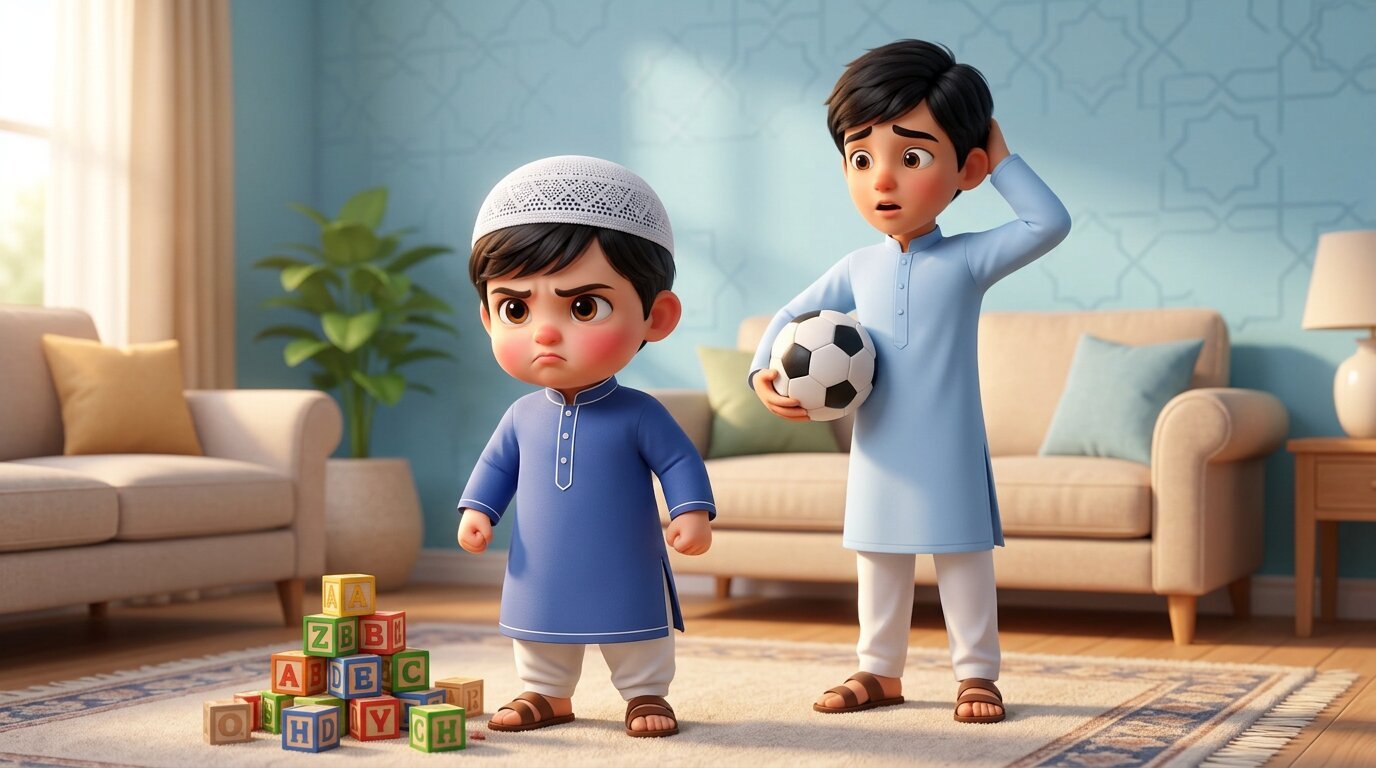

The tablet goes off. Two seconds later, the cushion flies across the room and your child is shouting louder than the pressure cooker. If that sounds like your evening, you are not alone. Almost every parent knows this scene, in Karachi and far beyond it.
This guide is about Islamic anger management for kids. Just five small steps from the Sunnah, explained in a way a child can actually use, plus what to change for each age, and the exact words you can say in the moment.
One quick note before we start. I am not a child psychologist or a scholar. Every hadith below has its reference so you can check it yourself, and for anything serious, please speak to a doctor or a trusted local scholar.
Anger Is Not the Enemy. Acting on It Is.
Many of us grew up hearing “Ghussa haraam hai!” every time we got upset. But the feeling itself is human. What Islam teaches is control. The Prophet ﷺ gave a new meaning to the word strong:
“The strong is not the one who overcomes the people by his strength, but the strong is the one who controls himself while in anger.” (Sahih al-Bukhari 6114)
Children love this one, especially boys who want to be superheroes. You can say: “Do you know who the really strong person is? Not the one who wins the fight. The one who can stop himself.” That single line changes the story from “you are bad” to “you can become strong.”
Allah also praises people “who restrain anger and who pardon the people” in Surah Al-Imran, ayah 134. So the goal is not a child who never feels angry. The goal is a child who knows what to do next.
The 5 Sunnah Steps: A Calm-Down Plan Kids Can Remember
I like to call it the “Stop, Say, Sit, Silent, Share” plan. Five words, one per finger, so a small child can count it on one hand.
1. Stop: Freeze the Hands
Before anything else, the hands stop. No hitting, no throwing. Teach it as a game: you say “Stop!” and everyone freezes like a statue. When anger comes, the freeze is already practised.
2. Say: A’udhu billahi minash-shaytanir-rajeem
Two men were arguing near the Prophet ﷺ, and one of them became red in the face. The Prophet ﷺ said he knew a word that would take that anger away if the man said it: “I seek refuge with Allah from Shaytan.” (Sahih al-Bukhari 6115)
For a young child, give the meaning in simple words: “Ya Allah, help me calm down and keep Shaytan away from me.”
3. Sit: Get Low
“When one of you becomes angry while standing, he should sit down. If the anger leaves him, well and good; otherwise he should lie down.” (Sunan Abi Dawud 4782, graded sahih by al-Albani)
Kids find this one easy because it is physical. “Anger is making you tall and stompy. Let’s get low.” Sit on the floor, the stairs, or a floor cushion.
4. Silent: Close the Mouth for a While
The Prophet ﷺ said, “When one of you is angry, he should be silent.” (Al-Adab Al-Mufrad 245) Words said in anger hurt the most and are the hardest to take back. Teach your child that this sentence is allowed: “I am too angry to talk right now.”
5. Share: Use Words Later
Once the storm passes, help your child put it into words. “I got angry because…” and “Next time I need…” This is where real learning happens, usually ten minutes or even an hour later, never in the middle of the shouting.

Abu and Arham from Arham Kids TV
A Small Note on the Wudu Hadith
You will see many posts that say “make wudu when you are angry” as a sunnah. The narration in Sunan Abi Dawud that links anger with wudu is graded weak (Sunan Abi Dawud 4784). A splash of cold water or a glass of water can still help a hot, upset child feel better. Just share it as a practical tip, not as a firm sunnah instruction.
Age-Wise Guide: What Works at 3, at 7 and at 11
Ages 3 to 5: Keep It Physical
- Use only two steps at first: Stop and Sit.
- Say the dua out loud for them. They will copy you long before they memorise it.
- Keep your sentences very short. “You are angry. Sit with me.”
Ages 6 to 8: Add the Dua and the Words
- Practise all five steps on a calm day, like a drill. Make it silly and fun.
- Give them a feelings word list: angry, sad, jealous, tired, hungry. A lot of “anger” at this age is really hunger or tiredness.
- Let them choose a calm spot in the house, like a corner with a cushion and a water bottle.
Ages 9 to 12: Talk About Why
- Share the hadith of the strong person and ask, “What does real strength look like in your class?”
- Help them spot their own triggers: losing a game, being teased, screen time ending.
- Let them plan their own response. A plan they make themselves is a plan they will use.
Real Desi Home Moments (and What to Say)
Most guides talk about board games and slammed doors. In our homes, the triggers often look a little different. Here are a few, with words you can borrow.
- Mobile or tablet time ends: Give a five-minute warning first. Then: “I know it’s hard to stop. Let’s sit, say A’udhu billah, and then you choose the next game.”
- Fight with a brother or sister: Separate first, judge later. “Both of you sit. No talking for one minute. Then each of you tells me what happened.”
- Guests are at home and the child melts down: Take them to another room calmly. No scolding in front of people. “Chalo, thori der ke liye hum dono baith jaate hain.”
- Homework anger: Pause the work. A glass of water, a short walk, then one question at a time.
If screens are a big trigger in your house, my list of screen-free activities for kids at home gives easy things to switch to when the tablet goes off.
What Not to Do
- Don’t shout back. Our children copy what we do far more than what we say. When you feel angry, say it aloud: “I’m getting angry, I’m going to sit down.” That is the best lesson they will ever get.
- Don’t label the child. Lines like “Tum to ho hi badtameez” stick for years. Name the action, not the child.
- Don’t punish the feeling. It is fine to be angry. Hitting, breaking or rude words still have a calm, clear consequence, like tidying what was thrown or saying sorry.
- Don’t teach only in the storm. Practice happens on calm days. In the storm, you only remind.
Anger control grows from the same daily habits as other manners. If you liked this, you may also find my guide on teaching kids good manners through daily routines helpful. And at bedtime, a calm story about forgiveness works wonders, so take a look at these Islamic bedtime stories for kids.
When to Get Extra Help
Most childhood anger is normal and slowly gets better with practice. Please talk to your child’s doctor or school counsellor if the outbursts are getting worse over months, if your child often hurts people or animals, or if they seem very sad or worried between outbursts. Asking for help early is a gift, not a failure.
Frequently Asked Questions
What dua should a child say when angry?
A’udhu billahi minash-shaytanir-rajeem, which means “I seek refuge with Allah from Shaytan, the outcast.” It comes from Sahih al-Bukhari 6115. For small children, a simple meaning is enough: “Ya Allah, help me calm down.”
At what age can I start teaching anger control?
You can start around age 3 with two simple steps: freeze the hands and sit down. Add the dua and feelings words around ages 5 to 7, when children can follow short routines.
Is it a sin for a child to get angry?
Feeling angry is a normal human emotion. Islam teaches us to control what we do with it. For children, the focus should be gentle teaching and practice, not fear.
Is making wudu when angry a sunnah?
The narration about wudu and anger (Sunan Abi Dawud 4784) is graded weak. Cool water can still help a child calm down, so you can use it as practical advice rather than a firm sunnah.
For more ideas like this, visit our Kids Corner page, where I keep all the kids learning posts in one place.
Get one small parenting or tech tip every day
Follow the By Tech Hatch WhatsApp channel for short, practical tips, new kids activities and Arham Kids TV updates. Join the WhatsApp channel here.